
San Bernardino County Court Records After Arrest
The local path is arrest, booking, prosecutor review, formal filing, then Superior Court case activity. A person arrested by the San Bernardino County Sheriff's Department, a city police department, CHP, or another agency may first appear in the county jail roster. That roster can show arrest agency, arrest date, housing facility, bail, and dynamically populated charges or holds. It is still not the final source for filed charges.
The Superior Court of California, County of San Bernardino criminal division and the Court Access Portal are the court-record sources named in the research. The San Bernardino County District Attorney reviews state and local criminal cases after arrest, and the court case becomes the authority for filed charges, case number, hearing dates, dispositions, and future court appearances. For custody and booking details, use San Bernardino County jail inmate records; for booking photos, use the San Bernardino County jail mugshots record path.
Find Court Records After Jail Arrest
Start with the court portal when the question is about filed charges, hearing dates, dispositions, or case status. Start with the jail roster only when the question is whether the person is in custody, which facility holds the person, or what booking facts the sheriff has published. The roster itself warns that court appearance dates may not be current and tells users to contact the San Bernardino County Superior Court for current court-date information.
- Use the jail roster to gather the booked name, arrest date, booking number, arrest agency, and housing facility if available.
- Open the San Bernardino Superior Court Court Access Portal for case lookup.
- Search by case number if known, or by party or defendant name when the case number is not known.
- Limit to criminal case information where the portal offers a case type or division filter.
- Review the filed charge list, case events, hearing dates, and disposition fields shown by the court.
- Use the clerk or official court locations page for older, limited, or courthouse-specific files.
The Superior Court criminal division page is the official court source matched to this record path.
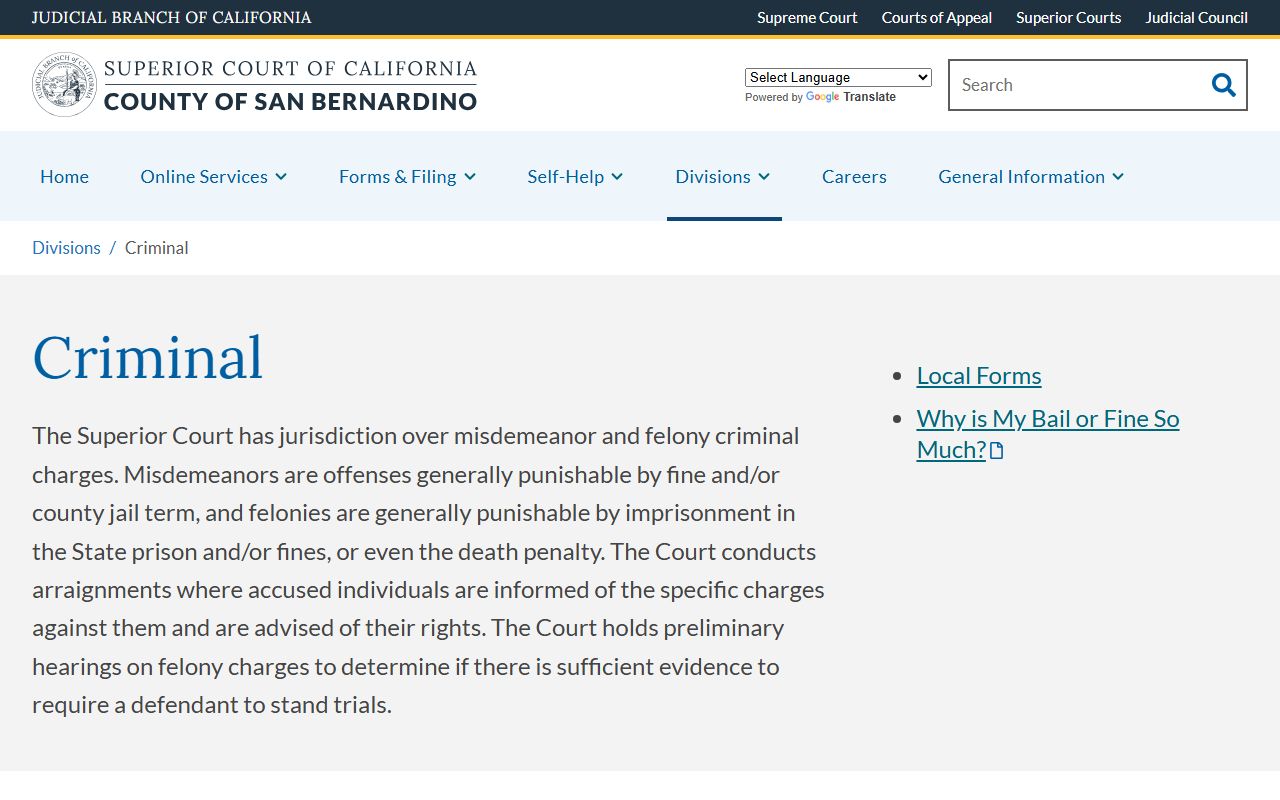
The court page is where the custody facts from the jail record turn into case filing, hearing, and disposition questions.
San Bernardino County Court Search Fields
The portal field capture in the research is general because exact labels can change in the live court interface. Even so, the search routes are clear enough to structure a court records after arrest lookup: use case number when it is known, use party or defendant name when it is not, and select criminal division or case type where available.
| Field Label | Type | Required | Notes |
|---|---|---|---|
| Case number | Portal search field | Usually optional if using name | Best route when the case number is known. |
| Party / defendant name | Portal search field | Usually optional if using case number | Use booked name and spelling from the jail profile as a starting point. |
| Case type / division | Filter or dropdown | Likely optional | Use criminal division where the portal allows it. |
| Search / Submit | Button | n/a | Exact live label should be verified at the portal. |
Charges Filed After San Bernardino Arrest
After a jail arrest, the booking charge can differ from the formal court charge. The District Attorney may file fewer counts, add counts, amend allegations, reduce a charge, or decline to file. Federal cases follow a different federal prosecutor and USMS path, and the San Bernardino roster says sheriff staff do not provide court and charge information for US Marshal records.
| Document | Who Files It | How It Fits After Arrest |
|---|---|---|
| Complaint | Prosecutor | Initial charging document in many California criminal cases after prosecutor review. |
| Information | Prosecutor | Felony charging document after preliminary hearing or waiver. |
| Indictment | Grand jury | Grand-jury charging document, less common for routine local cases but possible. |
San Bernardino Charge Status Terms
Charge status explains where a count stands in the court record. The status can change after the first filing because the prosecutor, defense, and court may resolve counts at different times. A charge is not the same as a conviction, and a dismissal on one count does not always end the whole case.
| Status | What It Means |
|---|---|
| Pending | The filed charge is not yet resolved. |
| Amended | The charge changed after filing. |
| Reduced | The charge was lowered, often through plea, prosecutor action, or court action. |
| Dismissed | The count ended without a conviction on that count. |
| Conviction | A formal adjudication, guilty plea, or verdict. It is not the same as arrest or booking. |
| Disposition | The final or current outcome of a charge or case event. |
Bond After San Bernardino Arrest
California release decisions can include cash bail, surety bond, own-recognizance release, supervised release, no-bail holds, warrants, sentenced status, and other court orders. The sheriff's roster bail disclaimer says the Sheriff's Department may accept bail in cash or through a surety bond under Penal Code 1269b. It also says property or equity bail may be accepted by the court but not by the jail, and that the Sheriff's Department may not recommend a bail agent.
| Release Type | How It Works |
|---|---|
| Cash bail | Accepted by the Sheriff's Department when bail is allowed and no other condition blocks release. |
| Surety bond | Posted through a licensed bail agent, but the sheriff cannot refer business to an agent. |
| Property or equity bond | May be handled through the court process rather than the jail counter. |
| Own recognizance | Release based on a promise to appear, ordered through court action. |
| No bail / hold | Custody continues until court action or another legal condition changes. |
Warrants and Court Records
No single official San Bernardino County Sheriff's active-warrant public list was confirmed in the inspected official sources. If a person is arrested on a warrant, the booking may appear in the Inmate Locator after county jail intake, but the warrant's issuing court, case number, and current status are court-record questions. Use the court portal, the clerk, and the sheriff's public-records process rather than third-party warrant sites.
Common warrant terms include arrest warrant, bench warrant, search warrant, and fugitive warrant or hold. A bench warrant often follows a missed court date or violation of a court order. A search warrant is not an inmate record. A fugitive hold or outside warrant may explain why release does not occur even when one local bail amount appears.
Charges Versus Convictions
A San Bernardino County court record after a jail arrest may show an accusation before it shows an outcome. The filed charge is the allegation being prosecuted. A conviction is a later result by plea, verdict, or adjudication. Treating the two as the same is a serious reading error.
| Charge | Conviction | |
|---|---|---|
| Stage | Accusation filed in court | Outcome after plea, verdict, or adjudication |
| Proof Level | Not a final finding of guilt | Formal criminal case outcome |
| Can Change? | Yes, charges can be amended, reduced, or dismissed | May be affected by appeal, relief, or later court order |
| Where to Verify | Superior Court case record | Superior Court case record and eligible DOJ self-review |
Sealed San Bernardino Court Records
California public access has limits. Juvenile records, sealed matters, protected victim information, ongoing investigations, and records limited by court order may not be public in the same way as ordinary adult criminal case records. Penal Code 851.91 allows eligible people to petition to seal arrest records after specified nonconviction outcomes.
| Sealed | Expunged / Dismissed Relief | |
|---|---|---|
| Public visibility | Limited from public view by law or court order | Depends on California relief type and record system |
| Law-enforcement access | May remain available for defined official purposes | May remain visible for defined criminal justice purposes |
| Typical trigger | Eligible nonconviction arrest sealing or protected proceeding | Eligible post-conviction or dismissal relief under California law |
| Where to start | Superior Court and California statute route | Superior Court and legal counsel for eligibility |
San Bernardino County Prosecutor Role
The San Bernardino County District Attorney handles state criminal filings after arrest. The current District Attorney identified in the research is Jason Anderson. Use the DA for who files or handles state criminal charges, the Superior Court for what charges are filed and what the case status is, and the sheriff for who is in jail and where that person is housed.
The District Attorney source is a useful agency identity point for the post-arrest charging path.
The DA source supports the charging-decision side of the pathway, while the court portal remains the source for the public case record.
Important: Court records after a jail arrest are public-record references, not consumer reports for employment, credit, tenant, or insurance screening.